 Make Moon a State
It is now more than half a century since human beings last walked on the Moon, and in that time the most powerful civilization in history has managed to do precisely nothing about it. This is not patience. It is not prudence. It is the kind of decadence that would have embarrassed the Romans. We possess the technology, the capital, and — one must assume, though the evidence grows thin — the nerve. What we lack is the honesty to say the plain thing: the Moon should become a state of the United States of America.
Not a colony administered by distant bureaucrats. Not a military installation dressed in the language of exploration. Not a mining concession operated for the quarterly enrichment of shareholders who will never visit. A state. With a constitution, courts, elections, and the full apparatus of self-government that Americans have spent two and a half centuries assembling, dismantling, and reassembling. The State of the Moon.
And it begins at the south pole.
The Opportunity
The Moon's surface area is about 14.7 million sq miles, roughly the Americas combined. Its gravity is 16.5% of Earth's, with a mean radius of 1,079 mi and diameter of 2,158 mi.123
Those numbers invite a question that most space policy evades: what do you actually do with a continent-sized world that sits three days away? The answer is you settle it. You build on it. You govern it.
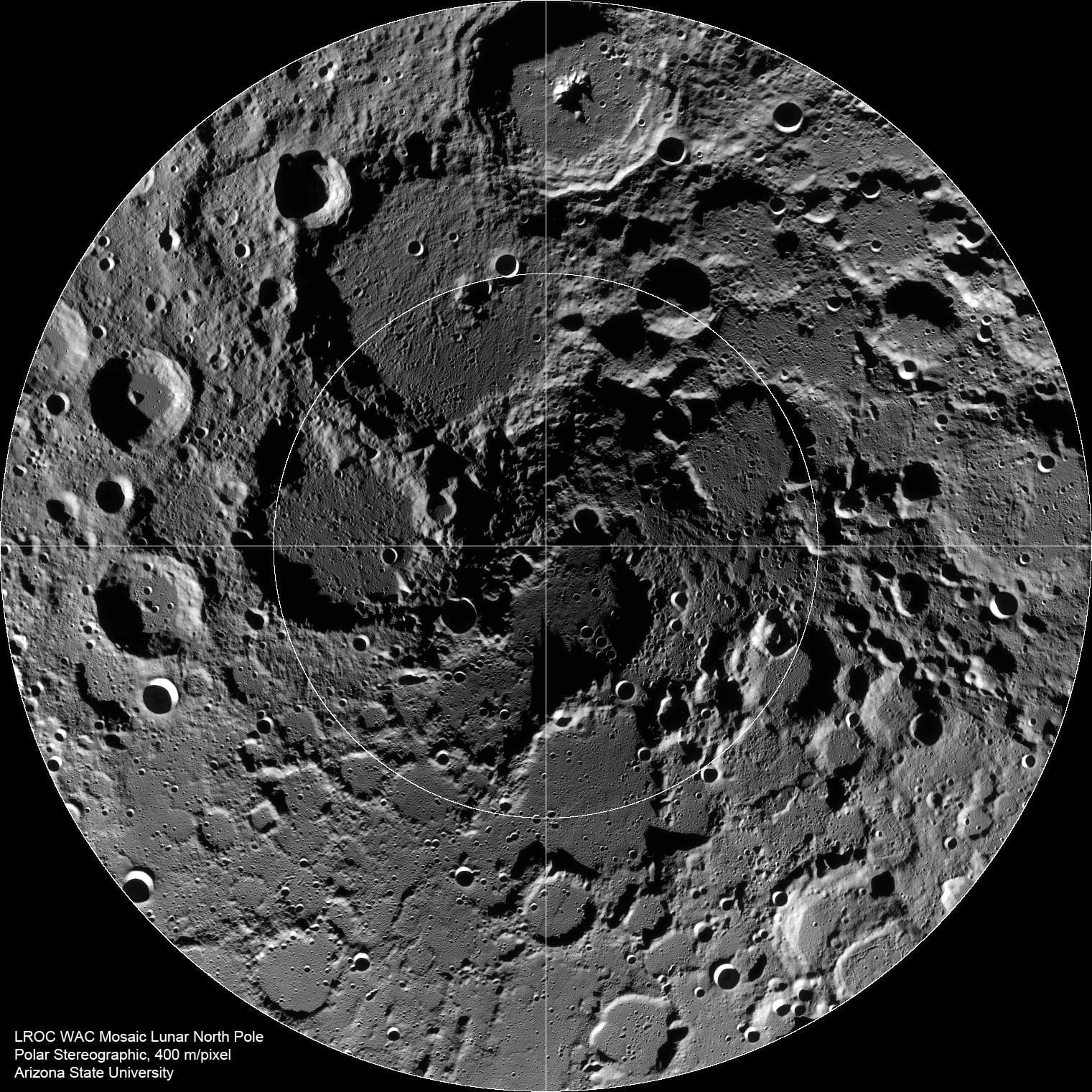
Almost all resources needed for life support and industry must come from local ice, regolith, and sunlight. Practical settlement starts at the poles where water-ice and near-continuous light coexist. Only a few thousand square kilometers meet both criteria today. But those locations can support tens of thousands of people once industrial infrastructure and heavy automation mature.
Early outposts of tens, then hundreds, of crew in the 2030s will grow to multi-purpose towns of 10,000 or more by mid-century. Fleets of autonomous excavators and haulers will operate at ratios of 5 to 20 robots per human. A polar colony provides exportable fuels, helium-3, and manufacturing feedstocks while offering radio-quiet far-side astronomy and a low-gravity shipyard for deep-space missions. These are capabilities impossible from Earth. They are reasons enough to go. But the real reason is older and simpler: this is what free people do. They expand.
Conservative financial models show lunar commodities and logistics slicing launch costs and creating new revenue streams within a space economy projected to top $1 trillion this decade. The following table is not speculation. It is the near-term business case for a civilization that has spent centuries perfecting the art of building wealth in hostile terrain.
Investment Areas
| Opportunity | Details | Financials |
|---|---|---|
| Transportation savings | Oxygen extracted from regolith and ice cuts cargo mass for lunar ascent stages by ~70% and lowers Earth-to-surface cost once Starship-class tankers refuel in lunar orbit | <$455/lb to lunar surface4 |
| Energy exports | Helium-3 content (roughly 20 ppb) could yield significant annual output once strip-mining reaches scale, supporting fusion-pilot-plant demand | 16.5 to 22.0 short tons/year, $1 billion/ton potential5 |
| Tourism | Sector analyses project strong lunar-tour revenue by 2035, helped by reusable landers and surface hotels | $2.5-5 billion/year by 2035 |
| Space Manufacturing | Regolith 3-D printing and sintering enable large mirrors, fiber-optic cables, and metal foams | Up to 60% capex savings for some optics manufacturing |
| Interplanetary Hub | Lunar staging point for Earth-Moon-Mars transport network, with in-situ fuel production | $50-100 billion market by 2035, $500+ billion cumulative by 2050 (SpaceX Mars colony logistics) |
| Scientific Infrastructure | Radio-quiet far-side astronomy enables next-generation radio telescopes and SETI research | $10-25 billion in NASA/ESA contracts by 2040, $100+ billion cumulative through international partnerships |
| Moon Segment | A diversified lunar economy (transport, power, construction, tourism, resources) will grow rapidly | $170 billion cumulative (to 2040), $2 trillion global space market by 2040 (Moon fastest-growing segment) |
High-latitude "peaks of extended sunlight" on crater rims receive illumination up to 90% of the lunar year. Adjacent permanently shadowed craters trap billions of tons of ice. The combined contiguous area with both light and ice is under 1,160 sq mi today. About the size of Los Angeles.6
That is where civilization begins again.
These sites, primarily around Shackleton and nearby craters, offer daytime temperatures near -58 F instead of the plus or minus 216 F swings common at mid-latitudes. Over decades, in-situ construction using sintered-regolith berms, buried habitats, and basalts melted into shielding blocks can open mid-latitude mare plains. Eventually at least 5% of the surface, some 734,000 sq mi, becomes habitable.789
Radiation and micrometeoroid hazards on the remainder require 6.6 to 9.8 ft of regolith shielding or underground placement.10
Top Roles and Salaries
A settlement is not an abstraction. It is a payroll. It is people doing work, earning wages, and building lives they do not intend to abandon. The following breakdown is what a functioning lunar economy actually looks like when you stop talking about it in the language of grant proposals and start talking about it the way a city planner would.
Life-support, mining, and power dominate head-count because they underwrite survival and export revenue. Science retains a large share because it drives innovation, patents, and prestige. Community, governance, and services stay lean. Automation and low-gravity logistics simplify goods movement enough to keep the bureaucracy small.
A settlement staffed along these lines can grow predictably. Each new tranche of miners and habitat engineers unlocks resources and pressurized volume for the next wave of residents. The service sectors scale just enough to keep morale high and operations safe.
Pilot Outpost, Years 0-10
Every person wears multiple hats. A life-support engineer doubles as an EVA technician. Scientists rotate through rover maintenance shifts. Nearly all surface tasks rely on 200 semi-autonomous robots tele-operated from the habitat. Nobody is idle. Nobody is irrelevant.
Industrial Village, Years 10-25
Permanent mining and power divisions emerge. Dedicated construction crews expand lava-tube interiors while agricultural techs ramp closed-loop food output. Population growth is paced by how fast ISRU delivers water, oxygen, and building mass. The economy is real. It has inputs and outputs and quarterly reports.
City-State, Years 25-50
The economy diversifies. Heavy industry and research draw talent from Earth. Education, retail, and cultural roles appear once families stay long-term. Robots rise to roughly 13 per human, covering routine inspection, hauling, and exterior repairs so people focus on design, science, and governance. This is no longer an outpost. It is a city. And cities need constitutions.
| Salary Rank | Role | Total Lunar Comp (2025 USD / yr) | Approx. Head-count @ 30k Settlement |
|---|---|---|---|
| 1 | AI Systems Engineer | $900k | 300 |
| 2 | ISRU Mining Engineer | $600k | 800 |
| 3 | Trauma / Flight Surgeon | $600k | 40 |
| 4 | Power Plant Chief | $590k | 20 |
| 5 | Mission Operations Director | $575k | 10 |
| 6 | Habitat Systems Engineer | $540k | 500 |
| 7 | Robotics Operations Engineer | $505k | 60 |
| 8 | EVA & Surface Technician | $480k | 1200 |
| 9 | Logistics / Lander Turnaround Chief | $450k | 40 |
| 10 | Planetary Geologist | $419k | 100 |
Those are not fantasy numbers. They are what you pay people to live somewhere that will kill them if the plumbing fails. They are also, not coincidentally, the salaries of a thriving middle class. No civilization in history has been built by people who could not afford to stay.
Phase I. The Democratic Settlement Protocol
Present space law is a gentleman's agreement written for an era of flags and footprints. It permits many activities. It blocks one core thing: territorial expansion. You cannot claim lunar land as sovereign territory. You can govern registered habitats and crews, hold elections inside them, own what you extract, and coordinate safety zones. But you cannot plant a flag that means what flags have always meant.
We intend to change that. Not by ignoring the law, but by replacing it with something better.
Phase I amends the Outer Space Treaty and hardens the Artemis Accords into enforceable rules. It creates Lunar Governance Zones around permanent settlements and gives the United States a clean, inspectable mandate to govern where its citizens actually live.
| Article | Rule | Practical Effect |
|---|---|---|
| I. Supremacy | Govern within designated LGZs and prevail over conflicting older provisions there by consent of the Parties | Settlement law applies where people live |
| II. Designation | An international commission publicly maps LGZs around permanent bases. Terms and renewal are on the record | Visible lines, visible duties, no secret fiefdoms |
| III. Exclusive Administration | US exercises legislative and judicial power inside its LGZ over persons, installations, and operations | Authority subject to inspection |
| IV. Eminent Domain | US may condemn and integrate rights-of-way, easements, and fixtures for public use with just compensation | Build power, water, and transit on public need |
| V. Open Visitation | Managed, reciprocal access for other Parties' representatives. Safety and notice are mandatory | Transparency and trust by design |
| VI. Due Regard 2.0 | Safety zones are proportionate, notice-based, and temporary. Unique science sites receive heightened protection | Deconfliction without de facto borders |
| VII. Resource Rule | Extracted resources belong to the extractor under governing law. Planetary-protection data are shared | You mine it, you own it. You report what you find |
| VIII. Review and Remedy | Bi-annual performance review. Abuse triggers curatorship. Compliance earns renewal or expansion | Power on probation |
Phase I is the ramp to legitimacy. Rules, courts, elections, and public works. Settlers gain rights and services. Rivals gain predictable access and inspections. The habit of Moon government takes root. And habits, once established, are harder to kill than treaties.
Phase II. The Sovereign Lunar State Treaty
Having proven democratic administration in the Governance Zones, we finish the arc.
The Parties agree, openly and by signature, to constitute the entire lunar surface and subsoil as a single US state. Permanent guarantees for access, inspection, and science remain. No ambiguity. No vacuum. No "first come, first carve."
Competing nations are barred from planting paper sovereignties or carving rival zones. The Moon becomes one jurisdiction, one constitution, one electorate.
| Article | Rule | Practical Effect |
|---|---|---|
| I. Constitutionalization | The State of the Moon is admitted with boundaries coextensive with the lunar surface and subsoil | Legal limbo ends. One flag, one set of courts |
| II. Lunar Supersession | Non-appropriation is replaced with a consent-based framework. Peaceful-purposes and WMD ban endure | Sovereignty by consent, stability by design |
| III. Non-Recognition | Parties reject any claim or "zone" that purports to create separate territorial rights on the Moon | No "first come, first carve" |
| IV. Freedom of Access | Landing, traverse, and overflight remain open under safety rules scheduled by the State of the Moon | Science and commerce flow under public law |
| V. Eminent Domain | The State of the Moon manages fixtures and rights-of-way with prompt compensation. Private installations retain status | Build the grid. Pay the bill. Keep trust |
| VI. Heritage Charter | Historic sites (Apollo, Luna, Chang'e) and fragile volatiles are protected. Planetary-protection protocols apply | Stewardship as a constitutional duty |
| VII. Inspection | International Lunar Inspectorate with scheduled access, public audit reports, and binding corrective plans | Do not trust. Verify |
| VIII. Dispute Settlement | Technical disputes go to a lunar tribunal. State-to-state disputes go to expedited arbitration with compliance bonds | Arguments end in courts, not corridors |
| IX. Transition | LGZs convert into counties. Safety-zone procedures become municipal ordinances. Licenses roll into state law | Continuity without chaos |
| X. Denial of Benefits | Non-SLST claims to insurance, launch, spectrum, traffic, or exports are denied | Compliance is not optional |
This is annexation by consent and inspection, not by fiat. Others keep access. The Moon keeps a constitution.
From Vote to Voice
The calendar is shorter than you think.
Louisiana doubled the nation with a signature. Texas joined as a state by resolution. California vaulted to statehood inside two years. The transcontinental railroad spanned a continent in seven. A President set a goal in 1961 and Americans walked the Moon in eight. Speed is not the obstacle. Timidity is.
| Phase | Legal Act | Target |
|---|---|---|
| 1. Foundation | Democratic Settlement Protocol ratified, first U.S. LGZ at the south polar plateau, organic act enacted | Year 0 to 1 |
| 2. Build | Eminent-domain grid plan, first public-works contracts, and lunar bond authority | Year 1 to 3 |
| 3. Belong | Non-Terrestrial Statehood Amendment ratified, civil rights and election law in force | Year 2 to 4 |
| 4. Admit | Congress seats the State of the Moon on equal footing | Year 4 to 6 |
| 5. Unify | SLST enters into force, LGZ counties unify the surface, non-recognition closes rival paths | Year 6 to 8 |
Precedents for speed. Texas annexed and admitted in 1845. California admitted 1850. The 26th Amendment ratified in about 100 days. The transcontinental railroad, 1862 to 1869. Apollo, 1961 to 1969. When America decides, the calendar obeys.
Now consider what happens if America does not decide.
China has published detailed plans for a permanent south-polar research station by 2035. Russia has signed on as a partner. Neither government holds elections it can lose. If the first permanent settlement beyond Earth is built in the image of a single party, the rest of the century will be spent trying to undo it. We will be negotiating access to a world we once walked freely, petitioning for science time on telescopes built with authoritarian labor, and explaining to our children why we let it happen.
Free government is not a spectator sport. We have a proven kit for liberty at scale. Clear legislation. Courts that uphold law. Elections that fire the inept. We have used it to settle a continent, win two world wars, and build the most productive economy in human history. The question is not whether the kit works. The question is whether we are still willing to use it.
A Call to Action
There are those who will call this grandiose. Let them. Grandiosity is what built every republic worth living in. The question is not whether the Moon can be governed — we have answered harder questions than that — but whether we are still the sort of people who do difficult things because they are worth doing, or whether we have become the sort who convene committees to study why difficult things are difficult.
China has published detailed plans for a permanent south-polar station by 2035, with Russia signed on as partner. Neither government holds elections it can lose. If the first permanent settlement beyond Earth is built in the image of a single-party state, the rest of this century will be spent petitioning for access to a world we once walked freely. That is not a hypothetical. It is a trajectory.
Sign. Share. Demand. Tell your representatives that the Democratic Settlement Protocol is not a thought experiment but a piece of legislation that needs drafting, now. The Sovereign Lunar State Treaty is not a fantasy but the natural conclusion of principles Americans claim to hold self-evident. If those principles stop at the atmosphere, they were never principles at all.
- 38 million km² (surface area)
- 1,737 km (mean radius)
- 3,474 km (diameter)
- <$1,000/kg (to lunar surface)
- 15 to 20 t/year (metric tonnes per year)
- 3,000 km² (combined area with light and ice)
- -50 C (approximate daytime temperature at sites)
- plus or minus 120 C (temperature swing at mid-latitudes)
- ~1.9 million km² (5% of lunar surface)
- 2 to 3 m (regolith shielding thickness)